
Manuscript Readiness Checklist
Finishing a draft and having a finished manuscript aren't the same thing. This checklist walks through twelve areas — purpose, structure, research, consistency, and more — so you know honestly what state your manuscript is in before it goes to an editor.

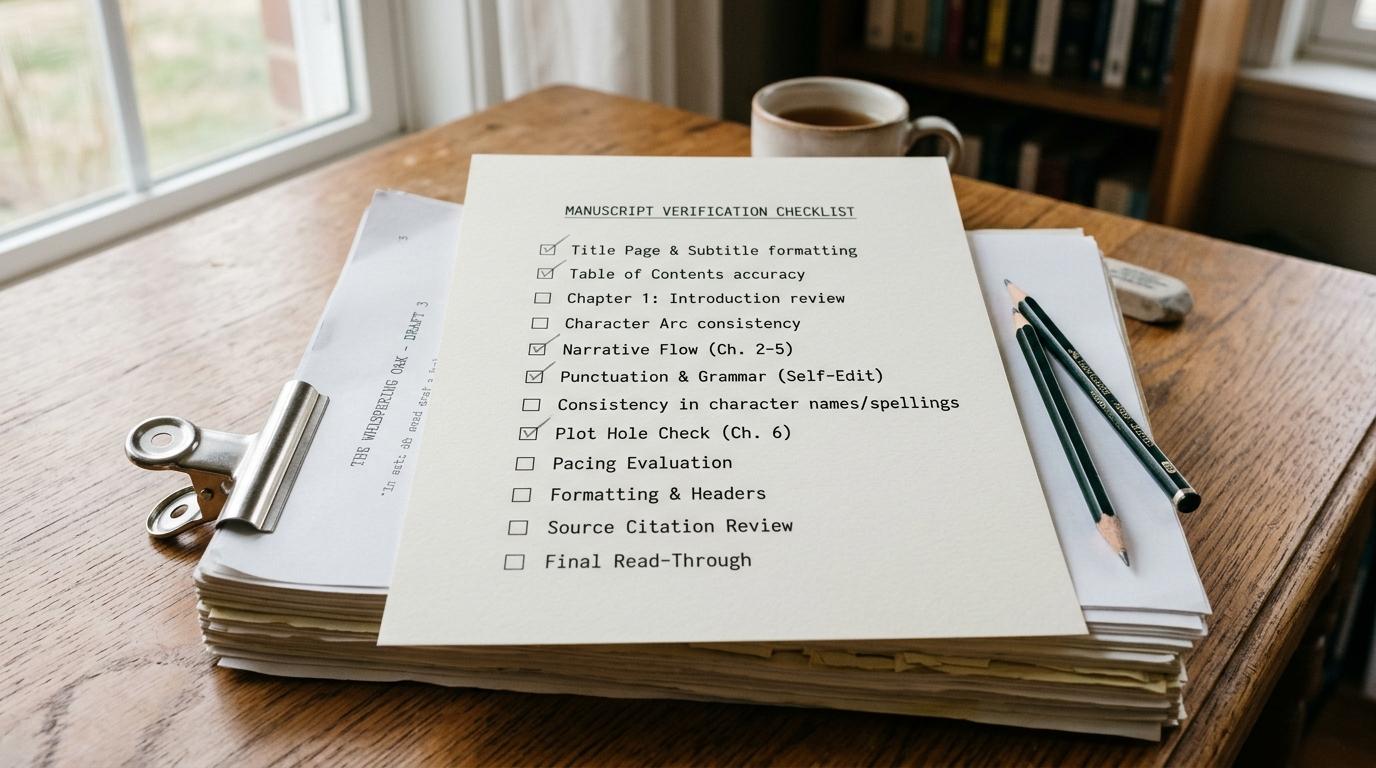
Finishing a draft feels like the finish line. It usually isn't.
You can reach the last page and still be sitting on a manuscript with an unresolved structure, chapters that quietly contradict each other, research you never double-checked, or a conclusion that doesn't actually follow from what came before. “Finished” and “ready” are two different claims, and conflating them is how manuscripts end up in an editor's inbox before they should.
Note: this checklist isn't asking for perfection. It's asking you to find out, honestly, what state the work is in before you move it forward.
Set aside twenty to twenty-five minutes to answer the items for a manuscript you know well. Checking each answer against the text takes longer, and for some items it should.
01 — Purpose & Core Idea
Quick test: Finish the sentence — this manuscript exists to... — and check whether your answer changes noticeably from chapter to chapter. If it does, that's a structural flag, not a phrasing problem. Before You Start Writing a Book is the place to go if that happens.
02 — Audience
Quick test: Who benefits most from reading this? If the honest answer is “everyone,” the audience isn't defined yet — narrow it.
03 — Structure
Structural test: For each chapter, complete — this chapter helps the reader ___. If you can't finish that sentence cleanly, the chapter isn't done yet, no matter how polished the prose inside it is.
04 — Content Development
05 — Research & Fact-Checking
If you're unsure how many citations a claim needs, or what readers actually do with them, Do Citations Make Nonfiction More Trustworthy? What the Research Shows looks at the evidence.
06 — Consistency
07 — Writing Quality
08 — Chapter-Level Review
Run every chapter through the same six questions:
If a chapter fails several of these, resist the urge to start line-editing it. The problem is almost never at the sentence level when this many boxes are unchecked.
09 — Introduction
10 — Conclusion
11 — Formatting & Presentation
12 — Final Read-Through
Put the checklist down for this part. Read the manuscript the way a reader would — start to finish, no editing pen in hand.
Does it hold together? Do you know where you are, as a reader, at every point? Where does your attention drop? Where do you get confused, or feel like you've read this already? What feels thin? What could disappear without the work losing anything?
Write down what you notice. Don't fix it yet — just notice it.
Manuscript Readiness Summary
Be honest here. This is the part people fudge, and fudging it just delays the real work.
Ready for editorial review — the core idea and structure hold up. What's left is editorial, factual, stylistic, or presentational.
Needs structural development — there's real material here, but the organization, argument, or chapter progression still needs work.
Needs further development — important sections, evidence, examples, or conclusions are still missing.
Not ready for final review — this is still functioning as an early draft or a collection of notes, not a manuscript.
That last category isn't a failure. Knowing a draft isn't ready is far more useful than sending an unfinished manuscript out and calling it done.
When readers' comments come back, The Feedback Signal Grid helps sort what's broken from what's only preference.
The question that actually matters
Before this goes to an editor or into publication prep, ask yourself one thing: if someone who knew nothing about this project read it start to finish, would they understand what you were trying to say?
If yes, you have something real to build on. If no, don't reach for the sentences first. Go back to the structure — because good editing starts with knowing what the manuscript is actually trying to become, and no amount of line-editing fixes a manuscript that hasn't decided that yet.
This resource was written by Victor and published by Focarix as part of the Focarix Knowledge Library.
© 2026 Focarix. All rights reserved. Readers and researchers are welcome to read, study, and share key insights. When quoting, referencing, or citing this checklist, please attribute Focarix as the publisher and include a direct link back to the original resource:
Working on something similar?
If you're developing a book, manuscript, or body of knowledge and want help with structure, editing, or publishing, tell us where you are.