
The Feedback Signal Grid: A Framework for Knowing Which Edits to Actually Make
Fourteen comments on a manuscript, and half of them contradict the other half. This framework sorts feedback into what's actually broken and what's just someone's preference, so you stop treating every opinion as equally urgent.

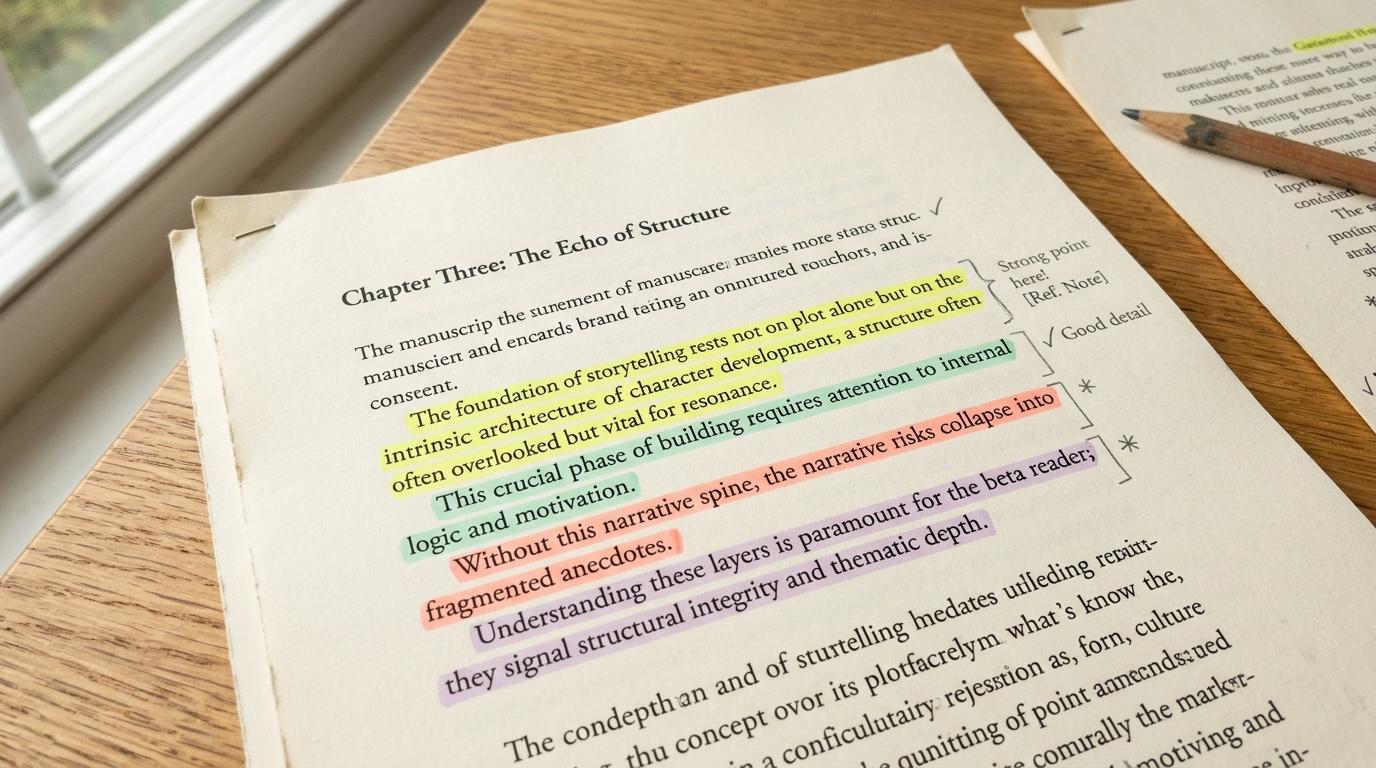
The manuscript comes back with fourteen comments. Follow all of them and half would undo the other half.
One reader says the opening is too slow. Another says it's the best part. A third wants more examples; a fourth thinks there are already too many. You sit there with a document full of red ink and no way to tell which comment is pointing at a real problem and which one is just a stranger telling you what book they would have written instead.
Most writers respond by either ignoring feedback altogether or trying to accommodate all of it. Both are mistakes, and they're really one mistake: treating every comment as equally diagnostic.
It isn't. Feedback fails writers constantly, but rarely because the readers were wrong. It fails because nothing sorts the comments before they hit the page.
Two things get collapsed into one, and that's the actual problem
Every piece of feedback is really answering two separate questions, and almost nobody separates them.
Is something actually broken here? A reader lost the thread, missed the point, or got confused. That's a clarity problem.
Would this reader have made a different choice? Different pacing, different voice, a section they'd have cut. That's a preference.
They feel identical when someone hands you a comment. They are not remotely the same thing to act on.
There's a second variable that matters just as much and gets ignored even more often: how many people, independently, land on the same spot. One reader flagging a section is a data point. Four readers flagging the same section without comparing notes is a pattern. Writers routinely treat those as the same weight of evidence. They aren't.
Put those two questions together and you get something you can actually use.
The Feedback Signal Grid
Sort every comment along two axes — what kind of note it is, and how many people independently raised it.
| Nature of note | One reader | Multiple readers, independently |
|---|---|---|
| Clarity issue(something didn't land) | Worth testing One person's confusion might be real, might be an outlier. Note it, watch for it again. | Fix it Independent readers hitting the same wall isn't taste. It's a structural signal. |
| Preference(they'd have done it differently) | Skip it This is one person's version of the book. It isn't yours. | Consider it, don't obey it A shared preference across several readers is worth understanding, but weigh it against what the piece is actually trying to do before changing anything. |
That's the whole framework. Two questions, asked of every comment before you touch a single sentence: what kind of note is this, and how many people are saying it without having compared notes first.
Applying it is mostly a sorting exercise, not a writing one
Run it after your own check, not instead of it. Readers are most useful on the problems you can't see yourself, so it's worth working through the Manuscript Readiness Checklist before anyone else reads the draft. Otherwise their comments get spent on problems you could have found alone.
When the comments arrive, go through every one and drop it into one of the four boxes. Don't fix anything yet. Just sort.
If the “fix it” box ends up smaller than it felt when you first read all fourteen comments in a panic, that's the grid doing its job. A comment that lands in “skip it” is useful information on its own: it tells you the manuscript isn't broken there, someone just wanted a different book.
The comments that land in “fix it” deserve your full attention first, before anything else. Those are the ones where multiple people, independently, tripped over the same clarity problem. That's not opinion. That's the manuscript failing to do its job in a specific spot, confirmed more than once. If the wall turns out to be structural, Why Good Ideas Need Structure Before You Write is about how those problems start.
Where this framework doesn't apply
Don't use this grid to filter feedback from someone whose entire job is seeing structural problems you can't see in your own work: a developmental editor, an agent, an experienced collaborator. Their single comment often carries more diagnostic weight than four casual readers combined, because they're trained to locate the actual mechanism behind a problem, not just report the symptom. Running their note through a frequency filter misses the point of having them read it at all.
It also doesn't replace your own judgment about intent. If three readers, independently, ask you to cut the chapter that carries the book's central argument, that's not automatically a “fix it.” That's a moment to ask whether the chapter is badly executed, or whether it's doing something readers didn't expect and don't want. Those need different responses.
And it doesn't apply to facts. If one reader says a date, a figure or a quotation is wrong, that isn't a note to watch for a second opinion. Check it today. Accuracy isn't settled by how many people notice the error.
The grid tells you where to look hardest. It doesn't tell you what to do once you're there. That part is still yours.
Four readers, three different responses
Say four beta readers read the same manuscript. Two mention, without prompting, that they lost the thread of the argument somewhere in the middle chapters. One says the ending felt rushed. One says they'd have preferred a more personal, first-person voice throughout.
Sorted: the lost thread is multiple readers plus a clarity issue, so it goes to the top of the list, no debate.
The rushed ending is one reader plus a clarity issue. That's worth a second look, not an immediate rewrite; check whether anyone else independently felt the same pacing drop.
The voice comment is one reader plus a preference. That's their taste, not a defect, and it stays exactly as written unless something else independently corroborates it.
Three comments handled with three different responses, in about the time it used to take to reread the same paragraph four times wondering who was right.
This resource was written by Victor and published by Focarix as part of the Focarix Knowledge Library.
© 2026 Focarix. All rights reserved. Readers and researchers are welcome to read, study, and share key insights. When quoting, referencing, or citing this framework, please attribute Focarix as the publisher and include a direct link back to the original resource:
Working on something similar?
If you're developing a book, manuscript, or body of knowledge and want help with structure, editing, or publishing, tell us where you are.